Loading...
Back to Projects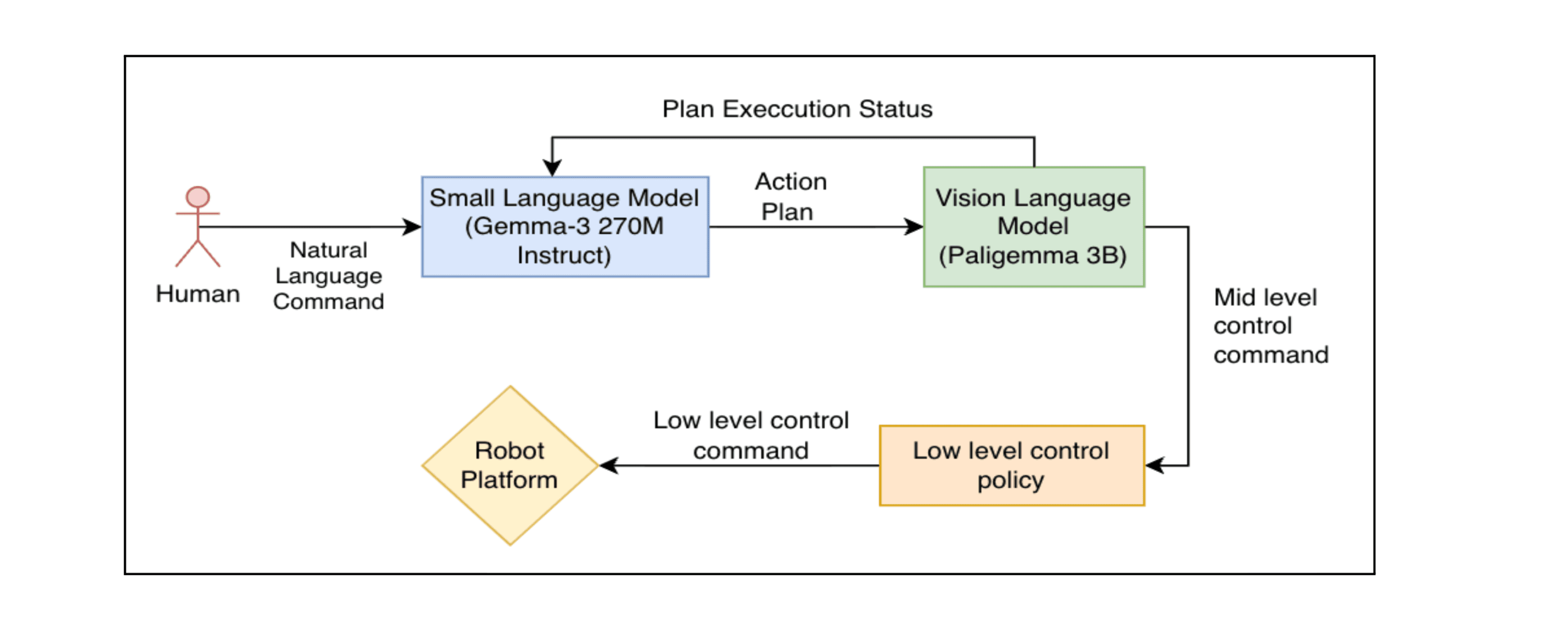
AIResearchRobotics2026
Hierarchical VLA Framework
A hierarchical vision-language navigation framework that separates high-level planning from low-level execution for natural language-guided robot navigation in complex indoor environments.
Project Overview
Conventional robotic navigation systems often fail because they rely on rigid goal representations, closed-world assumptions, brittle failure modes, and weak adaptation to dynamic changes during navigation. This project addresses those limitations with a hierarchical Vision-Language-Action (VLA) framework that decouples high-level planning from low-level execution. The high-level planner uses a Vision-Language Model to generate discrete navigation commands from three RGB camera feeds, while the low-level executor uses a reinforcement learning controller with depth-based safety execution on the robot platform. We recorded 200 episodes using live FantasyVLN (Qwen2.5-VL) across HM3D minival scenes. Each episode begins from a random spawn with a goal instruction, and captures 64x64 depth observations, the current VLM command, and the agent position and heading at every step. The low-level controller is a CNN-based PPO policy that conditions on depth input, high-level command context, and learned collision-avoidance patterns. Training was run for 1400 PPO updates, totaling about 2.9 million environment steps, on a single NVIDIA RTX 3090 Ti (24GB VRAM) via RunPod, with each run taking about 11.5 hours of GPU compute time. Ongoing work focuses on fine-tuning Qwen2.5-VL 7B on an object-goal navigation dataset generated on Matterport3D and HM3D using Habitat Simulator, and validating deployment on RunPod RTX 4090 32GB instances.
Architecture & Use Cases
Key Features
Hierarchical architecture that separates high-level planning from low-level execution
High-level Vision-Language Model planner that generates discrete navigation commands from three RGB camera feeds
Low-level PPO controller that uses depth observations for safer execution and collision avoidance
200 recorded FantasyVLN episodes collected across HM3D minival scenes for training and evaluation
Per-step state logging with 64x64 depth observations, VLM command context, agent position, and heading
Current high-level planner upgrade to Qwen2.5-VL 7B with Chain-of-Thought reasoning
Ongoing fine-tuning on object-goal navigation data generated with Habitat Simulator
Phase Breakdown
Phase 1
High Level Planner
- Uses a Vision-Language Model to produce discrete navigation commands from three RGB camera feeds
- Upgraded from an instruct model variant to a Chain-of-Thought vision-language model for stronger reasoning
- Moved from smaller 2B/4B models to a 7B parameter model for improved planning quality
Phase 2
Low Level Executor
- CNN-based PPO controller consumes depth camera input and high-level commands
- Trained with rollout length 2048, 2 epochs per update, minibatch size 256, learning rate 5e-5, entropy coefficient 0.05, value coefficient 0.25, GAE lambda 0.95, and PPO clip ratio 0.2
- Trained for 1400 updates and about 2.9 million environment steps on a single RTX 3090 Ti (24GB VRAM)
Images
Technology Stack
Backend
PythonROS (Robot Operating System)Habitat SimulatorPPO
Tools & Platforms
Qwen2.5-VLFantasyVLNPyTorchOpenCVRunPodNVIDIA RTX 3090 TiNVIDIA RTX 4090